
By Greg Nassief | Founder & CEO, Six Kind
Among the first surprises Americans encounter when living abroad is the difference in medication names, formulas, and availability. The process appears straightforward: bring a prescription from home and fill it locally. But in most countries, prescription equivalency is not a one-to-one relationship. The result is a small but persistent gap that affects everyone from remote workers to retirees.
Many common U.S. medications have different brand names abroad. Others are sold in alternate dosages. Some require a local doctor’s authorization before they can be dispensed, even when the medication is familiar and safe. Pharmacies may ask for records that travelers no longer carry. Clinics may request details about allergies, past reactions, or dosage history to ensure the correct local equivalent. These steps slow the process, not because care is lacking, but because systems are designed around their own regulatory frameworks.
Data from the International Pharmaceutical Federation shows that medication naming conventions differ widely across regions, particularly between North America, Latin America, and the EU. The issue is not one of safety but of alignment. A patient may be familiar with a U.S. brand, but the pharmacist abroad may know only the generic formulation or a local equivalent. Without the correct history, equivalence becomes a guessing exercise.
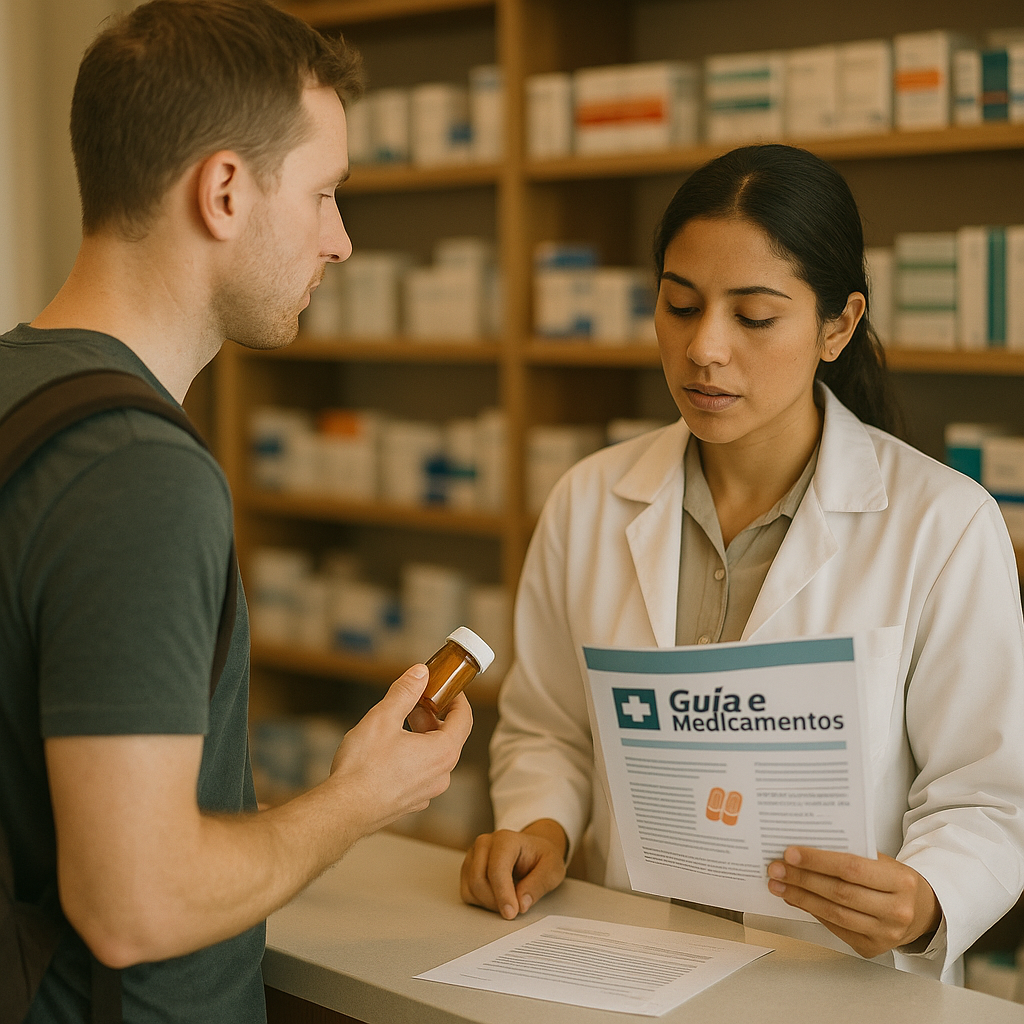
A typical scenario illustrates the problem. A professional living in Madrid needs a routine refill of a medication they have taken for years. The Spanish pharmacy asks for the active compound name, the dosage they’ve been on previously, and any history of side effects. The traveler has only the U.S. bottle. The pharmacist wants to help, but instead of a quick refill, the process requires a new local prescription. What began as a simple errand becomes a multi-step delay.
This is not unusual. Medication equivalency is one of the most common friction points for Americans abroad because the differences are invisible until they matter.
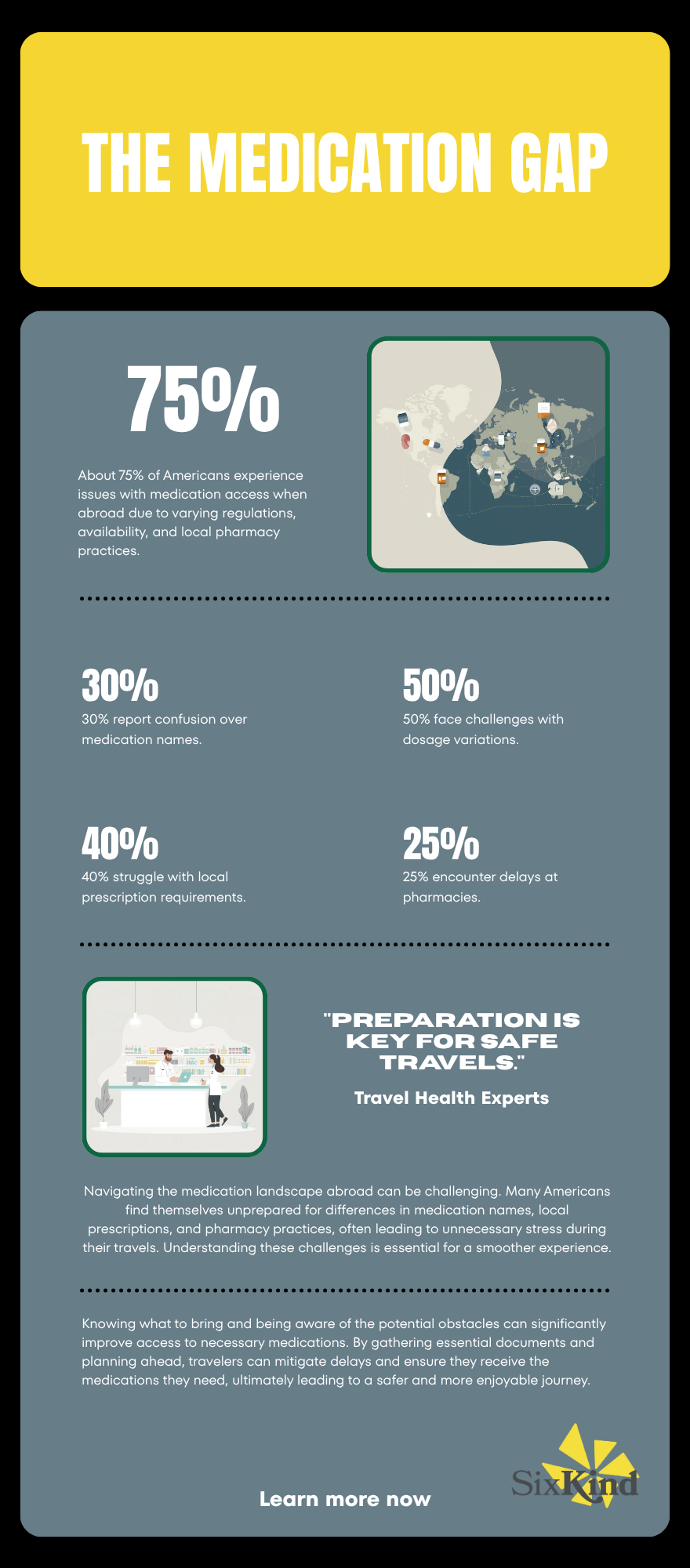
Three elements reduce these delays meaningfully. First, an accurate medication list—generic names, exact dosages, prescribing physician, purpose, and any history of reactions. Second, a portable medical summary that explains chronic conditions or ongoing treatments in plain language. Third, a knowledge of local pharmacy practices, including whether certain medications require an in-country prescription.
For travelers or residents living in multiple countries per year, these steps are essential. Even within the EU, policies differ. In parts of Southeast Asia, some medications are over-the-counter that would be prescription-only in the U.S., while others require a local consultation regardless of prior history. In Latin America, pharmacies often substitute brands, and documentation clarifies whether substitution is appropriate.
Affordability does not correct for system mismatch. Preparation does. The medication gap is not a crisis; it is a predictable coordination issue that responds well to structure.
Americans who live abroad successfully maintain a clear, updated list of all medications. They bring both brand and generic names. They understand which medications require local authorization. And they keep a concise medical summary available in both print and digital form. These steps shorten the distance between a refill and a resolution.
If you are planning to live abroad, prepare your medication information as carefully as your travel documents. A few minutes of organization can prevent hours of uncertainty when names, systems, and rules change.
FAQ: Medication Access for Americans Living Abroad
1. Why is refilling a U.S. prescription abroad sometimes harder than I expect?
Refills abroad are harder because health systems are built around local regulations, brand names, and prescribing rules—not U.S. ones. A pharmacist in Lisbon or Mexico City may recognize your medication’s active ingredient, but not the U.S. brand name or dosage you’re used to. Many countries also require a local prescription before dispensing certain drugs, even if you’ve taken them safely for years. Without a clear medication list and brief medical summary, the pharmacist or physician has to reconstruct your history in real time, which slows everything down.
2. Isn’t medicine abroad often cheaper and more accessible than in the U.S.?
In many places, yes—price and physical availability can be better than at home. That is the opposing view you’ll often hear: “Just buy it there; it’s easier and cheaper.” The problem is that cost and access are not the same thing.
Even when the medication is inexpensive and on the shelf, you may still need:
-
The correct generic name and dose.
-
Proof of your diagnosis or prior use.
-
A local prescription under that country’s rules.
Cheaper care does not remove the time lost when history is missing or systems don’t match. Preparation is what turns lower cost into real-world access.
3. What should I bring with me to avoid problems refilling prescriptions abroad?
A short, structured set of documents prevents most disruptions. At minimum:
-
A medication list with both brand and generic names, exact doses, and how often you take them.
-
A one-page medical summary (conditions, surgeries, allergies, key labs or imaging).
-
The name and contact details of your U.S. prescribing physician.
-
Clear notes about any previous side effects or drug intolerances.
This is the “subject expert” technique of anticipatory guidance: we assume typical points of failure and address them in advance. Pharmacists and clinicians abroad can then match you to the right local equivalent in minutes instead of hours.
4. Do I need to see a local doctor every time I need a refill?
Not always—but you should assume you might for certain medications. Rules vary by country and by drug class. In some places, blood pressure medications or certain antidepressants may be refilled with documentation alone; in others, any long-term medication requires a local consultation. Planning as if a visit will be needed—by having your history and medication list ready—turns that visit into a straightforward administrative step rather than a crisis.
5. Are generic medications abroad the same as the ones I take in the U.S.?
Often they are therapeutically equivalent, but the name, dose form, or combination may differ. For example, a drug you know as a single U.S. brand may be sold in multiple strengths or combined with another active ingredient overseas. This is where the second subject-expert technique—nuanced framing with clear limits—matters:
-
Equivalence is usually about the active ingredient and dose, not the brand.
-
Substitution should be based on your documented history, not guesswork.
-
When in doubt, a local physician or pharmacist should verify the match against your summary.
6. What is the biggest risk if I don’t prepare my medication information before moving abroad?
The most common risk is not dramatic harm; it is avoidable interruption. People run out of essential medications, spend hours finding a clinic, or experience delays because nobody has their history in front of them. For chronic conditions—cardiac, psychiatric, endocrine—those interruptions can accumulate into real health consequences. A small investment in organization (a Health Folder) keeps refills predictable rather than improvisational.
7. How often should I update my Health Folder once I’m living abroad?
Update it any time something important changes: new diagnosis, new medication, dose adjustment, or significant test result. Once a year, do a full review to ensure:
-
All medications and doses are current.
-
Your local clinic and pharmacy details are up to date.
-
Your U.S. physician and insurer contacts are still correct.