

By Gregory Nassief
Travel is roaring back. Global business travel spending is expected to return to roughly pre-pandemic levels—about $1.48 trillion in 2024—according to GBTA forecasts reported by Forbes. That means more executives on the road, more student programs abroad, and more exposure to medical risk. GBTA+1
What Travel Insurance Covers—and What It Doesn’t
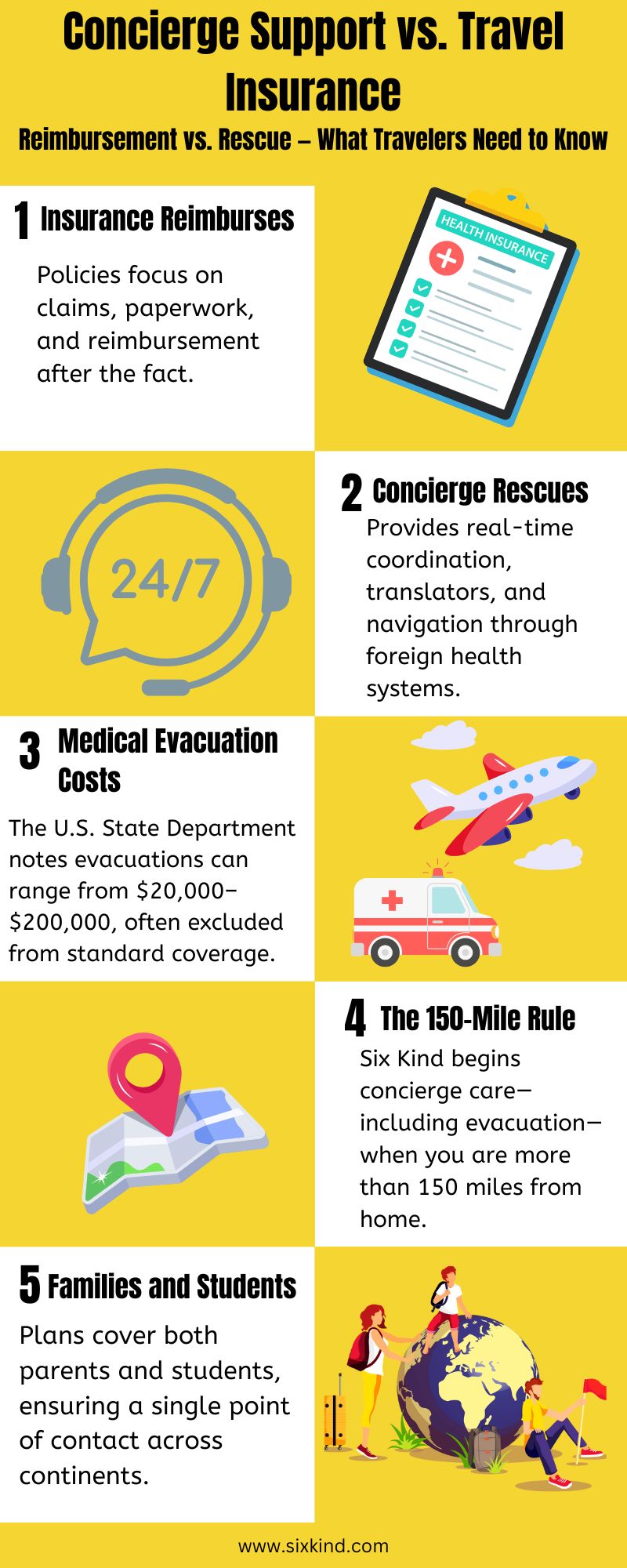
Most policies are designed to reimburse financial losses after the fact. They may pay for emergency transportation to the nearest adequate facility, but they typically do not coordinate care, provide translators, or navigate a foreign health system in real time. The CDC’s Yellow Book cautions that disruption policies may exclude medical care or evacuation altogether—travelers should evaluate add-on medical and evacuation coverage. Forbes Advisor likewise notes that “medical evacuation” coverage is specific and limited to transport, not bedside logistics. CDC+1
The Cost—and Distance—Problem
The U.S. State Department is blunt: most health plans will not pay to bring you back to the United States if you need an air ambulance, which can cost from $20,000 to $200,000 depending on distance and condition. The Department urges travelers to consider medical evacuation insurance. Travel.gov
Where Concierge Support Fits
Concierge medical support is not a substitute for insurance—it is the operational layer that insurance lacks. It handles live coordination, language support, local referrals, and care navigation when minutes matter. Six Kind begins comprehensive concierge support once you are 150+ miles from home—domestic or international—so the same response applies to a client on a routine stateside trip or a student across an ocean. (We design our services to complement whatever insurance you carry.) For travelers going to higher-risk or resource-limited destinations, both the State Department and CDC emphasize securing evacuation-capable coverage; concierge support ensures those benefits are activated smoothly when conditions on the ground are chaotic. Travel.gov+1
Families and Students Need a Single Point of Contact
U.S. study-abroad participation continues to rebound: 280,716 American students studied abroad for credit in 2022/23, up 49% year over year, according to IIE’s Open Doors report. Parents want assurance that someone will answer the phone at 2 a.m., speak the local language, and steer care decisions until their student is safe. A family-wide concierge plan closes that gap. IIE Open Doors
Bottom Line
Insurance is a financial instrument. Concierge support is an operating system for health crises. In an era of surging travel, real protection requires both.
Next Steps
Download the free guide: https://sixkind.com/free-guide-how-to-navigate-medical-safety-risks-abroad/
Compare membership options and speak with a concierge: https://sixkind.com
Sources: U.S. Department of State; CDC Yellow Book; GBTA via Forbes; IIE Open Doors. IIE Open Doors+4Travel.gov+4CDC+4